Thursday, July 21, 2016

Little Things


I’ve always found it a bit strange that the fairer sex, generally speaking, is afraid of mice.  Given the size advantage, females should be able to subdue any mouse.  Why then are women afraid of such diminutive creatures? I don’t have a good answer to this question, nor am I able to fully explain my fear of snakes and spiders.

I’m okay with any snake or spider that’s a respectable distance away from me.  Still, I walk with trepidation along pond banks or rock lined creeks or levees, as reptiles such as snakes, love to warm themselves in such places.  And, I would add, the early morning deer hunts that once took me deep into pre-dawn woods in mid-October carried the risk of me face-planting a spider in route to a deer stand location. Oh, the horror!

I can count on one hand the number of snakes I’ve seen on the grounds of my current home, but spiders are a different story.  And, just this year, I’ve remarked to family members as to the prevalence of cobwebs in nooks and crannies of our garage, around outside windows, and under the eaves of our house.  I sweep them down and they’re back in less than a week.  Thankfully, our pest control service keeps the inside of our house a relatively spider-free “safe zone.”

My wife was watching TV in our living room/den, last night, and it was not something I cared to hear or see, so I ventured to our guest house, intending to watch some early episodes of The Twilight Zone, via Netflix.

The porch area is not well lit, but I could see well enough to unlock the door.  No sooner had I stepped on the threshold, when I walked face first into a cobweb.  There may have been a spider in the web, I cannot say.  However, in the melee that followed, and it was a melee of flailing arms and hands about my face and head, I dislodged my glasses, knocking them onto the tiled entrance to the living room.

I can see without my glasses, just not very well.  Yet, I could see them lying on the floor in a twisted shape, much like person who just fell from a high precipice.  In that moment, I felt the agony of the Ralphie in A Christmas Story when he stepped on his glasses, breaking them.  I even had empathy for the bank teller in an episode of The Twilight Zone, who loved to read and was the sole survivor of an H-Bomb blast with access to all the books of the now demolished Public Library, who accidentally broke his glasses, and was left anguished and alone at the show’s end.

The clinic that keeps me in eyewear is closed today. I have attempted to straighten and bandage the frames of my glasses.  Presently, they are perched somewhat angly-gogling on the bridge of my nose with one earpiece resting higher than the other earpiece. A thin rubber band, think ponytail holder, keeps one lens in its proper place. None of this is pretty, but it works well enough for me to do most of the things I want to do.

Little animals frighten some people; little arachnids frighten others. Some of us respond to our fears rationally, while others of us may lean toward being irrational. Life, itself, is merely a compilation of little things and events that from a world view are insignificant, but on the personal level are experiences to be remembered, cried over, or laughed at.  I choose to laugh at this one.

Wednesday, January 06, 2016

Opal Austin ~ Eulogy

At some point, at or near the time of my entrance into this world, my mom and dad lived in a duplex in Pontotoc with Colonel and Opal Austin. This was a milestone in the life of my family and in the relationship between the Carters and the Austins. Perhaps, seeds were planted around that time that would later bring to fruition a business partnership lasting roughly a decade and a half.

Carter & Austin Grocery was formed in the mid-fifties and was a family owned and operated business. There were few workers that were not family members. After school and on Saturdays, both my older brother and I worked in the store, as did the two Austin brothers, Billy Carl and Paul David.

Miss Opal was not a full time employee, but she would often drop by to help "clean up." The woman was a whiz with a feather duster. Dad was not too keen on using a feather duster, claiming it only stirred up the dust. Yet, that didn't stop Miss Opal from her appointed rounds. I can still picture her "flying in" to dust the canned goods or straighten up a work area. She was the human equivalent of the cartoon character named the Tasmanian Devil.

I don't know if Miss Opal's parents gave much thought to the meaning of "Opal," but "opal" comes from the Latin opalus, meaning seeing jewel, and she was definitely a jewel. Maybe they knew that symbolically "opal" expresses "hope, happiness, and truth," all desirable characteristics for their newborn.

With four children to tend, a husband, and all that goes with a household to maintain, I once wondered where she got the energy to do all the things she did.

At age 53, Miss Opal went back to school. As a bright student of Science, she soon earned enough college credits to become a Licensed Practical Nurse (LPN), and later worked at the hospital in Pontotoc.

Opal also took in boarders during the natural gas pipeline construction days in the sixties, ran a day-care center in the seventies, and, somewhere along the way, found time to pursue an artistic interest in painting, both in oils and water color.

As long as I knew her, Miss Opal had a thirst for knowledge. She knew the Bible as well as a lot of preachers. If she had not been "died-in-the-wool Church of Christ" she'd have been a lot more fun in the scholarly/ theological sense. I always respected her, though I expect she'll be more surprised to see me in Heaven, than I will to see her.

Since 2000, my mother-in-law has been in the same nursing home with Miss Opal. And each time I visited my mother-in-law I would also visit Miss Opal. I was always impressed with Miss Opal’s positive attitude and sense of humor, and I never left her room feeling worse than when I entered.

Many of her Nursing Home days were spent limited by a nerve/ muscle dysfunction, that left her unable to walk and wheel-chair bound. Her Common sense and her medical knowledge stimulated her to maintain a modest exercise regime. She extended her exercise program to her mind, too, reading as she would say, "anything I can get my hands on."

Even in the confining atmosphere of a nursing home, Miss Opal continued to express herself in various forms.

• She was once President of the Resident Council at the Pontotoc Hospital Nursing Home.
• As a church member, she attended the Church Of Christ as often as possible.
• As an encourager, she visited with other residents in the nursing home, talking with them, and sharing unabashedly her good humor with all.
• As a seamstress, she sewed for other nursing home residents and even made a few christening gowns to be passed from her grandchildren to the generations that follow.

At a time when most folks in their upper eighties might have thought of slowing down, Miss Opal, like the Energizer Bunny, just kept going and going.

In fact she kept going right up to 95. The big difference between the Energizer Bunny and Miss Opal is she didn’t have replaceable batteries to keep her going. Her earthly batteries just ran down. However, the Miss Opal that we have known has been made NEW, and she now dwells in a new body that will never grow old and never wear out.

I doubt she’s using a feather duster today, but I’m confident she’s busy doing whatever it is folks do in GLORY LAND and looking forward to the day when she will help welcome us there.

Sunday, July 01, 2012

The Day I Died


Not Current Issue
June 27, 2012, started like a typical day.  I was up and preparing breakfast before seven o’clock. I had already checked to see if there were two hummingbirds at my feeders or just one. The bacon was done, my egg was ready, and just as the biscuits were being taken out of the oven I heard Barbara’s phone ringing in the bedroom.  Moments later Barbara came into the kitchen where I was busy buttering biscuits and handed me the phone.

The caller was Floyd McCullough, a long-time friend, who enjoys ribbing me whenever possible.  He told me he saw my obituary in Pontotoc’s weekly newspaper, The Pontotoc Progress, and was calling to confirm it wasn’t really mine.  Of course, the age listed was a dead give-away (no pun intended) that the deceased wasn’t me, as I don’t yet appear to be an eighty-nine year old, but that didn’t stop Floyd from kidding me.

After breakfast, I set about tossing my neighbor’s kudzu back down the hill after pulling it from my shrubbery.  It’s a task I repeat about five times during the warm months until a killing frost stops the dreadful vine in its tracks, where it lies dormant until spring. Having satisfied myself that the kudzu would wallow around for a few weeks before seeking higher ground, I cut some tall hedges at the rear of our house and used my riding mower to pull the limbs to the road to await pick-up by city employees later in the week.

The unseasonable cool morning air coaxed me to start mowing. Yet, mindful of the need to stay hydrated, I went inside to get some water around eleven a.m. and saw I had a missed call from another friend, Kenneth Prewett.

It seems Floyd wasn’t the only person who wanted to confirm the Wayne Carter in the obituary section of the paper wasn’t me. Kenneth shared the deceased was a resident of Arkansas but had a daughter who worked at a bank in Pontotoc.

It was Kenneth’s call that prompted me to post a notice on Facebook so that friends would know I was still around. Within minutes, several friends responded with “likes” or comments thanking me for letting them know my situation. One friend commented her husband reads the obituaries each morning to see if he should go to work.

One of the comments posed the question as to had the obit really been mine, “what would [I] have wanted to get done, said, etc., before kicking the proverbial bucket(list)?” 
The comment was sufficient to remind me that I wrote my own obituary about a year ago.  I doubt anyone will use it, but perhaps, it will serve as a guide for whatever my family chooses to submit to the newspaper.

There are many things I’d like to do before the grim reaper comes calling, but there’s not enough money for me to do them all.  I don’t have a bucket list, per se, but I’ve a short list of things of things I’d like to see and/or do while time permits.  If I’m able to check them off, I’ll start another short list…no sense in rushing myself to complete a lengthy list for fear of dying before completing all the tasks.

I don’t know how many Wayne L. Carters are left, and while I don’t expect to outlive all of them, I hope it’s a while before the name that pops up in the obituaries of the Pontotoc Progress is really mine.

Wednesday, December 28, 2011

Problem Solver ~ That’s Me :-)

For most of my career with SUPERVALU I was a problem solver. Oh, “problem solver” was never part of my job title, but it certainly was part of my job in Retail Technology and during my supervisory years as a meat specialist.

Problem solving has been so much a part of my adult life (perhaps all of my life) that I find myself solving problems almost subconsciously. Before one thinks I’m boasting, I should point out that all solutions to the problems I encounter aren’t necessarily the best solutions, and sometimes I’m not satisfied with the solution that I come up with.

Still, that doesn’t discourage me from trying to solve whatever problem I face. With respect to a given task, I’m always interested in finding a better way to complete it. Even when writing, I often rephrase a thought to better suit me. I’d like to think I’ve gotten better at communicating my thoughts over the past fifteen years that I’ve penned and shared my thoughts and deeds with others, but I’m probably not the best judge.

Since volunteering practically full time with Habitat for Humanity, I’ve been challenged to keep up with the tools I use on the job site. I’ve been known to lay down my hammer, only to discover it’s not where I put it when I went to pick it up again. I have a tool belt that helps with this sort of problem, but it only helps when I wear the tool belt, which is not all the time I use a hammer.

For the past two months, I’ve worked mostly toward creating office space and a board room in an old warehouse. Along with that goes plumbing and electrical work, so it’s a lot like remodeling an old house. With other volunteers working alongside me, it makes tool and equipment organization more difficult because we’re basically using “company” equipment and each person has a much right-of-use as the next person.

In the past week, two utility knives that I “carry” at work have gone missing; I don’t have a clue where my speed square is, or, for that matter, the location of my personal screwdriver.

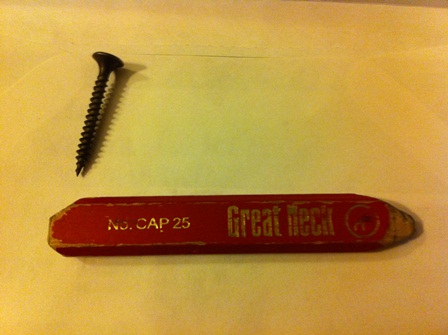
A month ago, I had two carpenter pencils in my tool belt; today there’s not even one. I did find a used carpenter pencil the other day that had once been sharpened at both ends. It must be getting old, because the lead was pulling loose from the wood that secures it. I discovered this while trying to sharpen it. The utility knife I was using to shave off the wood would grab the lead and pull it out the end of the pencil.

I found a solution that I believe illustrates my problem-solving abilities. No, I didn’t find a way to stop the lead from getting inadvertently pulled out of the pencil while sharpening it. But, I did find a way to continue using the pencil for several more days without sharpening the lead. No, no, I didn’t find a hardener to keep the soft lead from dulling when scribing lumber for cutting or marking starting and ending points for a chalk-line on wallboard or sheetrock.

Are you ready for the solution? I fashioned it into a mechanical pencil, one where the barrel is fixed but the lead moves back and forth inside the barrel.

I know, I know, you want to know how I did that. Okay. I put a sheetrock screw in the other end of the pencil. The diameter of the screw is slightly larger than the hole in the pencil filled by the lead. The screw is about an inch and one-fourth long, so I can “hand” screw it deeper into the hole to push more lead out the other end. Eventually, I’ll have to cut more wood from one end of the pencil to continue using it for whatever purpose a carpenter pencil is needed.

Barbara, my wife and Executive Director of Pontotoc County Habitat for Humanity, has since supplied us with a new box of carpenter pencils, but I’m kind of fond of the one I’m using, and nobody else has asked to borrow it.

Before ~


After ~

Monday, December 19, 2011

A Funny Thing Happened On The Way To Choir

Dressing for our recent Christmas Music program, presented by the Adult Choir of FBC, Pontotoc, I picked a white shirt from those in my closet and the bright red tie our choir director gave me to wear with my white shirt and black pants. Once I completed tying the fore-in-hand knot and was satisfied with the length (a man’s tie should hang no lower and no higher than the top of his belt buckle), I noticed the tips of the collar seemed to be missing the stiffness I expect from my shirts.
I didn’t want to be late for the six o’clock mandate to be IN the choir room and seated, and I was somewhat fearful I’d be tardy if I could not quickly locate a pair of collar staves. Finding them, I rushed into the living room where Barbara was seated and asked her to insert the staves into the sleeves underneath the collar. I did so because my hand to eye coordination while looking in a mirror is not my best attribute.
Barbara had trouble seeing where to slip the stave into the underside of the collar and told me she needed better light. I began to back away from her with her still hanging onto my collar and had almost reached the light switch when she said she could then see better.
“It went through!” she exclaimed.
“What are you talking about?”
“It came out the button hole,” she stated.
‘What button hole?”
“The one at the end of your collar.”
“Oh, good grief! I put on a button-down collar. Just fasten my collar to the buttons,” I sighed.
If this is the start of our growing old together, the two of us may be in for a bumpy ride.

Wednesday, December 07, 2011

Do We Remember Pearl Harbor

There’s a lot of hype today, December 7, 2011, about never forgetting the dastardly deed we remember as Pearl Harbor. Truly, in the lifetime of most of us, it’s an event eclipsed only by the terrorists’ act of 9/11/2001.

In subtle ways we’ve long forgotten Pearl Harbor. Yes, a movie about it still shows up on TV every so often, and the media reminds us of the anniversary, but in our day-to-day lives, we don’t remember.

We continue to buy Japanese automobiles in numbers so great that most American automobile manufactures now struggle to stay in the black, financially. Before China started making everything for us, we bought a lot of TVs, radios, and gadgets made in Japan. Even then, did we stop and think that our purchase was enabling the nation that crippled our naval fleet and left so many Americans dead or wounded back in ’41? I doubt many thought about it.

But, Pearl Harbor was only the beginning of the atrocities by the Japanese. They normally chose to fight to the death rather than surrender, thus, many American lives were lost as our military sought to capture Pacific island after Pacific island. Captured soldiers were treated horribly by the Japanese, but who cares to remember that in our “global economy?” Instead, we continue to question our ethics in the use of the atom bomb to bring Japan to the peace table.

We live for the moment, and as a people, we could not care less about Pearl Harbor. Ask anybody under the age of twenty-five what happened on December 7, 1941, and there will not be many who know. The reason is simple, we’ve forgotten, too, and it happened so long ago that it’s no longer relevant to our younger generation.

Surely, many of us have not forgotten and many of us will never forget, but our numbers are shrinking.

Sunday, October 30, 2011

One-Man Gui-tar

Our motel in Naivasha, Kenya, modest by American standards, was transformed into something of a nightclub on weekends. We had been forewarned that there would be loud music on the weekends. What wasn’t revealed was that the music played well into the morning hours.
It’s rare that I hear music, any music that I enjoy listening to. There are just not that many places that play songs by Bill and Gloria Gaither. I like a little music in my life, but like preaching, it doesn’t take a lot to do me. But, stick me in an automobile where I can’t control the radio, set me down in a church pew and play and/or sing a contemporary-style song or two, or bed me in a motel with loud music playing while I’m trying to drift off to sleep and I’m miserable. Here, I associate the word misery with Chinese water torture.
So, I’m an odd sort of bird, who has very limited likes when it comes to music. However, I do enjoy really good music, just not the sort that appeals to the masses, certainly not much of what shows up on shows like American Idol.
I wouldn’t have enjoyed the music at the motel any better had it been sung in my native tongue and not Swahili. I don’t listen to the words unless it’s a ballad or a gospel song, and as far as I could tell, the singer was singing American country music, but not the Patsy Cline or Hank Williams songs that are dear to my heart. Fortunately, I was so tired both Friday and Saturday nights that the music didn’t keep me awake all night.
Our group wanted a change from the typical evening meals served at the motel, so we let staff know we’d be ordering pizza. They provided us a dining room adjacent to the band area. Our driver, known only as Ben to me, was invited to dine with us. Our meal coincided with the start time for the band. I could hear guitar music, a singer, and drums. When I asked Ben about the band, he told me it was a one-man gui-tar. I don’t think I can break down guitar as he pronounced it, but he accented both syllables equally.
It sounded like a small group of musicians to me, so shortly afterwards, I slipped away to check out this one-man gui-tar. Just as I thought, there was a drummer pounding away on a set of drum, you know, a big bass drum a couple of snare drums and cymbals. I returned to share my discovery with Ben.
“Yes,” he smiled obligingly, “It’s a one-man gui-tar.”
“But he’s got a drummer.
“It’s a one-man gui-tar,” Ben insisted.
Still curious, I pressed him for additional information.
“What do you call one guitar player, one drummer, and a second vocalist?”
“It’s a one-man gui-tar.”
By this time other team members had started listening to our conversation.
“What if there are three singers?
“It’s a one-man gui-tar.”
I continued to add an extra singer until the count reach five and each time Ben’s answer to my question was, “It’s a one-man gui-tar.”
“Okay, I see the pattern here, Ben. What do you call one man playing a guitar with a choir of singers?”
Are you ready for this one?
“A choir.”
“Dang,” I silently mused, then asked the obvious, “At what point between five vocalists and a choir does the definition of a one-man guitar change?”
Ben laughed and explained any band with one guitar player and one or more vocalists is simply called a one-man gui-tar. It’s only when a second guitar player is added the terminology changes and the group playing/performing is called a band.
See, if I hadn’t gone to Kenya, I’d have never known what a one-man gui-tar is.

Saturday, October 29, 2011

Ask For Neal

Packing enough clothes for a 15-day trip oversees into two checked bags is enough of a challenge, but as we were carrying tools to use on a worksite, keeping the weight of the bags under fifty pounds became something of a problem. Barbara and I decided to purchase a large duffle bag to hold mostly my things and some tools. We also bought a small duffle bag for me to use for a short stay at a safari lodge as well as to accommodate the luggage restrictions of the small aircraft that flew us to the game conservancy.
Suffice it to say, the large duffle bag was a mistake. With its bulkiness, and at just under fifty pounds, it taxed both my strength and my pleasant disposition every time I had to move it. Why I didn’t buy one with wheels is a question I’m still asking. Let’s just say the unwieldy device was enough to make a preacher cuss.
Clothes tend to shift around inside a duffle bag that’s not bursting at the seams. We did a lot of motel hopping in Kenya, so what was in the middle of the bag one night might be at the end of the bag the next night or a night or two later. Organization was a nightmare, but adding to the nightmare was the fact that our motels, by and large, lacked spaces allocated for baggage. There were none of those nice little folding racks found in cheap American motels. Conditions for living out of a suitcase were less than ideal.
I swore I would buy a large suitcase with wheels before lugging the duffle bag back to Pontotoc, but with the dollar’s weakness against the schilling, a bargain was not to be found. And, going through check-in at the airport in Nairobi on the night of our departure, I was still lugging the cumbersome, loathsome duffle bag.
I had left some clothes for the disadvantaged in Kenya and all the tools were donated to Habitat for Humanity, but part of the weight of these was offset by the souvenirs we had bought. It was a few pounds lighter than before, but not by a noticeable amount.
Check-in went fairly normal. I handed over my passport for scanning, a boarding pass was issued, and my bag was checked and strapped with a luggage tag, and a luggage stub was affixed to the back of my boarding pass.
Three hours later, around midnight, we filed, orderly, aboard the airplane that would take us to London. I had hardly gotten comfortable in my window seat when an airline representative boarded and asked if I were Mr. Carter.
I assured her I was, and she handed me another luggage stub, stating simply, “This has your baggage claim number.”
I pocketed it, all the while wondering why I had two stubs and only one bag.
After deplaning in London, a couple of our team members, including me, had to pick up a boarding pass at the American Airlines counter, as there had been a printer problem back in Nairobi. The very nice lady, who issued my pass, informed me there was no bag on our flight that matched the claim number assigned to me. I then retrieved the stub given me after boarding in Nairobi. It matched a bag on the flight, but she said I would have to go to the gate and identify the bag before it could be stowed aboard my flight to Chicago.
An agent adjacent to her had been tuned in to what we were discussing, and he said, “That’s my flight,” which I supposed to mean he would be assisting at the gate.
“Don’t worry, Sir,” he stated, “I’ll meet you at the gate and take you down to identify your bag. Just ask for Neal.”
But, as you might suppose at airports such as London’s, the gate assignment for my flight was not immediately forthcoming, especially since I was looking at a more than four-hour-layover. Fortunately, when traveling with a group, time passes more quickly than when traveling alone.
When we finally were in line to access the gate (lots of security in London) there was no Neal. I spoke to an agent at the gate desk and explained I was to meet Neal about a matter of luggage. Shortly afterwards, Neal arrived, found me and told me the baggage was not yet at the gate but should be shortly.
“I’ll find you as soon as the baggage is here,” he assured me.
“I’m easy to spot,” I replied, “in my red jacket with Ole Miss on the front.”
About ten minutes passed and Neal motioned for me to follow him. He was wearing a lime-green security vest, so I wondered what other passengers thought as I followed him from the waiting area. He led me into a room where another security guard met us and from there we went through security doors accessible by badges and passcodes.
At some point, Neal asked about Ole Miss, “Isn’t that the college in the movie Sandra Bullock was in?”
Knowing he was talking about the Michael Oher story and the movie “Blind Side,” I respondeded affirmatively, somewhat surprised by his memory. The other guard accompanied us at all times. An exterior door was raised and there sat my duffle bag on the pavement.
“Is this your bag?” Neal inquired.
I could see my name tag on the handles as well as the red/white/blue ribbon tied onto one end, and I responded, “Yes, it is. My name is on the name tag.”
Neal didn’t take my word of it he bent down to flip over the name tag, read it, right himself, and quiz, “The Bodock Post?” even, pronouncing bodock correctly.
“Yeah, that’s my newsletter,” I replied.
We chatted briefly about my hobby as we made our way to the waiting area of the gate via a different route of security doors. I looked inside my billfold to find my last Bodock Post business card and gave it to him. He gave me his, as well.
I thanked him for his helpfulness and was generally impressed with his politeness and professional manner, to say nothing of London Heathrow’s security measures. Fly American, I say, and if you do get to London Heathrow Airport sometime ask for Neal.

Thursday, October 27, 2011

Kenya Motel ~ Heritage Club Resort

While we were lodged in Kenya, Barbara and I found our accommodations adequate for our needs, though nothing of the sort we expect from motels in America, the lone exception being the Serena Lodge at the Masai Mara wildlife preserve. We spent more nights at the Club Heritage Resort (motel) in Naivasha than anywhere else. For protection from malaria carrying mosquitoes, we slept under netting to prevent mosquito bites. Apparently it worked for as far as I can tell, I received no mosquito bites during the two weeks we were in Kenya.
Because Kenya is situated on the equator and the climate in Naivasha was mild, we did not need air-conditioning or heating systems to remain comfortable at night. Personal hygiene by the Kenyans we met seemed adequate, but for whatever reason, washcloths and hand towels were not provided by the motels. Barbara and I each had one bath towel, but that was all.
We had closet spaces but no dressers in our rooms, thus living out of a suitcase was more difficult than normal. The bathrooms consisted of a wall-mounted lavatory with a mirror, a commode, and a shower, all in a space roughly four feet by seven feet, with no vanity, no shower curtain, and virtually no hot water.
The shower head contained an electric water heater, but it did not function very well. Most everyone in our group, including me, reported taking cold to lukewarm baths. I would complain, except having seen the makeshift shower stalls the more than 335 families living in one of the IDP (Internally Displaced People) camps, I’m grateful the motel had an indoor facility, and I didn’t have to bathe out of a plastic container.
We enjoyed private dining for breakfast and dinner, which was a nice treat. The same members of the motel staff served us daily. There was plenty of food to choose from, but very little that appealed to me. I almost converted to vegetarianism while in Kenya, because I found very little meat that I could chew and swallow.
For my first few days in Kenya, I ate the pale-yolk eggs that were served. I tried them scrambled and the eggs looked white. I tried them fried and they looked white. I tried an omelet with peppers and cheese and it too looked white. I don’t think I tried them again.
The sausages served for breakfast looked awful and tasted like cheap bologna. Twice we were served bacon, and twice I tried to figure out what part of the pig it came from. It didn’t have enough fat to come from the belly and wasn’t lean enough to be Canadian bacon.
A few mornings I tried the fresh fruit selections, but generally I shied away from fruit. I don’t trust the handling fruit procedures in America, and I surely don’t in a third-world country. So, I ate a lot of toast and jam or toast and peanut butter for my breakfasts.
Our evening meals at the motel offered some variety from our noon meals eaten thirty miles away, but by the end of the week, I had given up chewing anything they called beef. As an old meat man, I’ve cut just about every part of a steer from the head back and down, but I’ve never seen meat that had gristle throughout it.
Early on in my Kenya trip, I learned that most any of the vegetable combinations or stews could be combined with the ever-plentiful rice. I also learned to put enough hot sauce on the food to make it go down easier. I never went hungry, but after two weeks in Kenya I came home ten pounds lighter.
While I may have grumbled and complained about my life in Kenya, it should not be construed that I didn’t have a good experience. As I told a teammate, "I wouldn't take anything for experiencing Kenya for two weeks, but I can't think of anything that would merit my returning."